
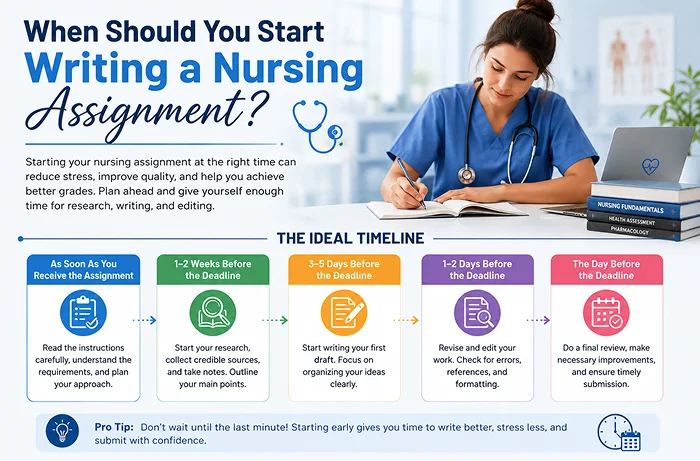
When should you start writing a nursing assignment? Ideally, nursing students should begin working on an assignment three to four weeks before the submission date. Starting early provides enough time to understand the question, conduct reliable research, prepare a clear structure, write the first draft, and review the final work.
Nursing assignments often require more than general academic writing. Students may need to apply clinical evidence, nursing theories, professional standards, ethical principles, and reflective models. Effective preparation therefore reduces stress and helps students produce a well-supported academic response.
How Early Should You Start a Nursing Assignment?
Most students should start a standard nursing assignment at least three weeks before the deadline. Longer assignments, dissertations, case studies, and evidence-based projects may require four to six weeks.
The exact starting point depends on:
- The required word count
- The complexity of the assignment question
- The number of academic sources needed
- Placement, employment, and family commitments
- The student’s confidence in academic writing
- Whether the task includes reflection, data analysis, or a case study
A reliable nursing assignment guide should encourage students to divide the task into manageable stages rather than attempting to complete everything in one sitting.
Why Is Early Nursing Assignment Planning Important?
Early nursing assignment planning gives students time to understand what the assessment is actually asking. Many students lose marks because they begin writing before identifying the main instruction words, such as analyse, evaluate, compare, discuss, or reflect.
Starting early also allows students to:
- Clarify confusing requirements with a tutor
- Access books and journal articles before other students
- Check whether sources are current and relevant
- Connect theory with nursing practice
- Improve arguments through editing
- Correct referencing and formatting mistakes
For nursing students UK, early preparation is particularly important because assignments may need to reflect professional values, evidence-based practice, patient safety, confidentiality, and relevant healthcare guidance.
A Practical Nursing Assignment Timeline
The following table provides a simple schedule for completing an assignment before the deadline.
| Time Before Deadline | Main Task | Expected Outcome |
| 4 weeks | Read the brief and marking criteria | Clear understanding of the question |
| 3 weeks | Conduct nursing assignment research | Strong collection of academic evidence |
| 2 weeks | Prepare an outline and begin writing | Completed introduction and main sections |
| 1 week | Finish the first draft | Full assignment ready for review |
| 3–5 days | Edit, reference, and proofread | Improved clarity and academic accuracy |
| 1 day | Final checks and submission | Assignment submitted on time |
This timeline can be adjusted according to the length and difficulty of different university nursing assignments.
How to Write a Nursing Assignment Step by Step
Students asking how to write a nursing assignment should begin by analyzing the assessment instructions. The assignment brief usually explains the topic, learning outcomes, required format, word count, and marking criteria.
1. Understand the Assignment Question
Identify the topic, instruction word, and limits of the question. For example, a question may ask students to evaluate communication in adult nursing rather than discuss communication across every area of healthcare.
2. Conduct Nursing Assignment Research
Good nursing assignment research should include peer-reviewed journal articles, academic books, professional guidance, clinical policies, and trustworthy healthcare publications.
Students should avoid depending on unsupported websites, outdated articles, or general sources that do not relate directly to nursing practice. Notes should be organized by theme so that evidence can be connected to specific sections of the assignment.
3. Create a Nursing Assignment Structure
A clear nursing assignment structure normally includes the following:
- An introduction explaining the topic and purpose
- Main paragraphs organised around key themes
- Evidence, analysis, and practical application
- A conclusion summarising the main argument
- A correctly formatted reference list
Each paragraph should make one central point. It should then provide evidence, explanation, critical discussion, and a link back to the assignment question.
4. Write the First Draft
The first draft does not need to be perfect. Its purpose is to develop the argument and place ideas in a logical order. Students should focus on answering the question rather than trying to make every sentence flawless immediately.
5. Edit and Proofread
Editing should check whether the assignment is analytical, relevant, and supported by evidence. Proofreading should focus on grammar, spelling, punctuation, referencing, and presentation.
How Can You Avoid Last-Minute Nursing Assignments?
The best way to avoid last-minute work is to treat nursing assignment deadlines as final submission points rather than starting points. Add the deadline to a calendar and create smaller personal deadlines for research, planning, drafting, and editing.
Students can also use short study sessions. Completing 300 words or reviewing two articles each day is more manageable than attempting an entire assignment the night before submission.
Remove distractions during writing sessions, keep research materials organised, and begin with the easiest section when motivation is low. Consistent progress is more effective than waiting for the perfect time to start.
When Should You Start Writing a Nursing Assignment?
When should you start writing a nursing assignment? Begin approximately three to four weeks before the deadline for a standard assessment. Start even earlier when the task involves extensive research, complex clinical evidence, or a high word count.
Early preparation improves the quality of research, supports stronger critical analysis, and creates enough time for careful editing. It also reduces the risk of rushed writing, weak referencing, and missed submission dates.
FAQs
How early should you start a nursing assignment?
You should normally start three to four weeks before the deadline. Larger projects may require four to six weeks.
What is the best time to start writing a nursing assignment?
The best time is immediately after receiving the assessment brief. Early reading and planning make the writing stage easier.
How do you plan a nursing assignment?
Break the assignment into research, outlining, drafting, editing, proofreading, and submission stages. Set a separate deadline for each stage.
How can you avoid last-minute nursing assignments?
Use a weekly schedule, complete small tasks regularly, limit distractions, and aim to finish the first draft at least one week early.
How can you finish a nursing assignment before the deadline?
Prepare a realistic timeline, prioritise the most important sections, write consistently, and reserve the final few days for editing and referencing.
Final Summary
When should you start writing a nursing assignment? Starting three to four weeks early is usually the safest approach. A planned schedule gives nursing students enough time to research credible evidence, develop a logical argument, follow the correct structure, and submit confident academic work before the deadline.















One Response
hello